Traffic Filters Trial - Oxford
We are asking for your views and experience of Oxford’s traffic filter trial.
Your feedback will help future decision making about whether and how to continue with the traffic filters.
The traffic filter trial replaced Oxford’s temporary congestion charge on Monday 28 September 2026.
The traffic filter trial aims to reduce congestion in the city, creating a healthier, more accessible and attractive Oxford.
The filters are designed to work with other measures to:
- reduce traffic
- make bus journeys faster
- allow for new and improved bus routes
- make walking and cycling safer
- reduce local air pollution
- improve the health and wellbeing of our communities
What a traffic filter is
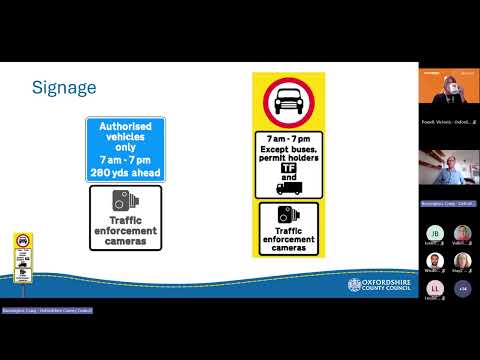
A traffic filter is a camera-enforced point on a road where certain types of traffic aren't allowed through at certain times. The six trial traffic filters in Oxford only restrict cars without a permit. Cars with valid permits and all other vehicles can travel through them at any time.
Traffic filter locations and operating days and times
You can view an online map of the traffic filter locations or maps of individual traffic filters under Documents on this site.
Location | Days of operation | Times of operation |
Hythe Bridge Street | Monday to Sunday | 7am - 7pm |
St Cross Road | Monday to Sunday | 7am - 7pm |
St Clement’s Street | Monday to Sunday | 7am - 7pm |
Thames Street | Monday to Sunday | 7am - 7pm |
Marston Ferry Road | Monday to Saturday | 7am - 9am and 3pm - 6pm |
Hollow Way | Monday to Saturday | 7am - 9am and 3pm - 6pm |
The traffic filters operate all year round, including bank holidays. However, outside of the hours of operation, any vehicle type can pass through, with or without a permit.
Free permits
Permits are available to allow some cars (those categorised by the DVLA as M1) to travel through the traffic filters during their hours of operation. All permits are free.
The traffic filter permits are 'virtual'. You will not receive a physical permit to display in your car. The cameras at the traffic filter point will read your number plate and check for a valid permit.
As a resident, you may qualify for a free permit that gives you day passes:
- Oxford permit area (100 free day passes)
- Oxfordshire permit area (25 free day passes)
Permits are also available for the following groups:
- Blue Badge holders
- Organisational Blue Badge holders
- Disabled tax class vehicle
- Personal car used by community health or care worker
- Organisational shared cars (pool cars)
- School car used for home-to-school transport
- Unpaid carer
- Frequent hospital patient
- Disability benefit claimant
- School student with special educational needs (SEND)
- Firefighters
- Hackney carriage or private hire vehicle
- Car clubs
- Business car used as a goods vehicle
- Personal car used as a goods vehicle
- Approved driving instructor
- Hearse or funeral car
- Magistrates driving to Oxford’s Magistrates’ Court
Traffic filters enforcement
Automatic number plate recognition (ANPR) cameras check all vehicles moving through traffic filters. You will get a fine if you go through a traffic filter without a valid permit.
The fine is £70 (reduced to £35 if paid within 21 days).
If you do not pay the fine within 28 days, it increases to £105.
During the first six months of the traffic filter trial, the council will send a warning notice (not a fine) for the first contravention of driving through a traffic filter without a valid permit.
What is an Experimental Traffic Regulation Order?
Experimental Traffic Regulation Orders (ETRO) are used when it is difficult to assess the impacts of the scheme beforehand. In an ETRO, the council introduces the scheme as an experiment first, and there is then a six-month consultation period when the public can see for themselves the impact of the scheme, and the council can monitor its impacts.
The ETRO may remain in force for a maximum of 18 months, before which a decision will be made as to whether or how to continue with the scheme.
If the provisions of the experimental orders are made permanent, the measures will be incorporated into the existing Oxfordshire County Council local Traffic Regulation Orders.
What happens next?
The county council will review the responses and prepare a report to be presented to the cabinet before the expiry of the ETRO. This will be a public meeting at which members of the public may apply to speak. The agenda and reports for cabinet meetings will usually be made available on the Oxfordshire County Council website about a week before the meeting.
-
 Oxford Traffic Filters ETRO - MADE ORDER 2026.pdf (9.16 MB) (pdf)
-
Oxford Traffic Filters ETRO - MADE NOTICE.pdf (152 KB) (pdf)
-
Oxford Traffic Filters ETRO - STATEMENT OF REASONS..pdf (148 KB) (pdf)
-
 Traffic filter maps
-
Oxford traffic filter locations (1.39 MB) (pdf)
-
Hythe Bridge Street 7am to 7pm (809 KB) (pdf)
-
Thames Street 7am to 7pm (855 KB) (pdf)
-
St Cross Road 7am to 7pm (2.58 MB) (pdf)
-
St Clement’s Street 7am to 7pm (5.35 MB) (pdf)
-
Hollow Way 7am to 9am and 3pm to 6pm (1.06 MB) (pdf)
-
Marston Ferry Road 7am to 9am and 3pm to 6pm (6.62 MB) (pdf)
-
-
Assessments
-
Strategic asssessment (2.1 MB) (pdf)
-
Business impact assessment.pdf (2.27 MB) (pdf)
-
Equalities Impact Assessment (1.84 MB) (pdf)
-
Equalities impact assessment - Addendum (1.15 MB) (pdf)
-
Air quality report.pdf (5.61 MB) (pdf)
-
Climate impact assessment (176 KB) (pdf)
-
Road safety assessment.pdf (933 KB) (pdf)
-
-
Transport and traffic forecasting report.pdf (1.7 MB) (pdf)
-
Local model validation report (4.26 MB) (pdf)
-
Monitoring and evaluation plan (2 MB) (pdf)
-
Monitoring and evaluation plan - Summary.pdf (318 KB) (pdf)
-
Traffic filters presentation.pdf (1.58 MB) (pdf)
-
Traffic filters trial SURVEY to print (562 KB) (pdf)
-
Traffic filters trial - business survey to PRINT (545 KB) (pdf)